

Awareness, practice and play: the three threads behind how I teach
My philosophy of teaching voice is held together by three threads: awareness, practice and play - and built on a foundation of feeling safe in your own voice. Underneath that sits detailed, ever-evolving and evidence-based voice pedagogy.
But fundamentally my job isn't to tell you the "right" way to sound. You'll show me, and tell me, what your right way is. My job is to help you find it, and to give you the tools to get there.
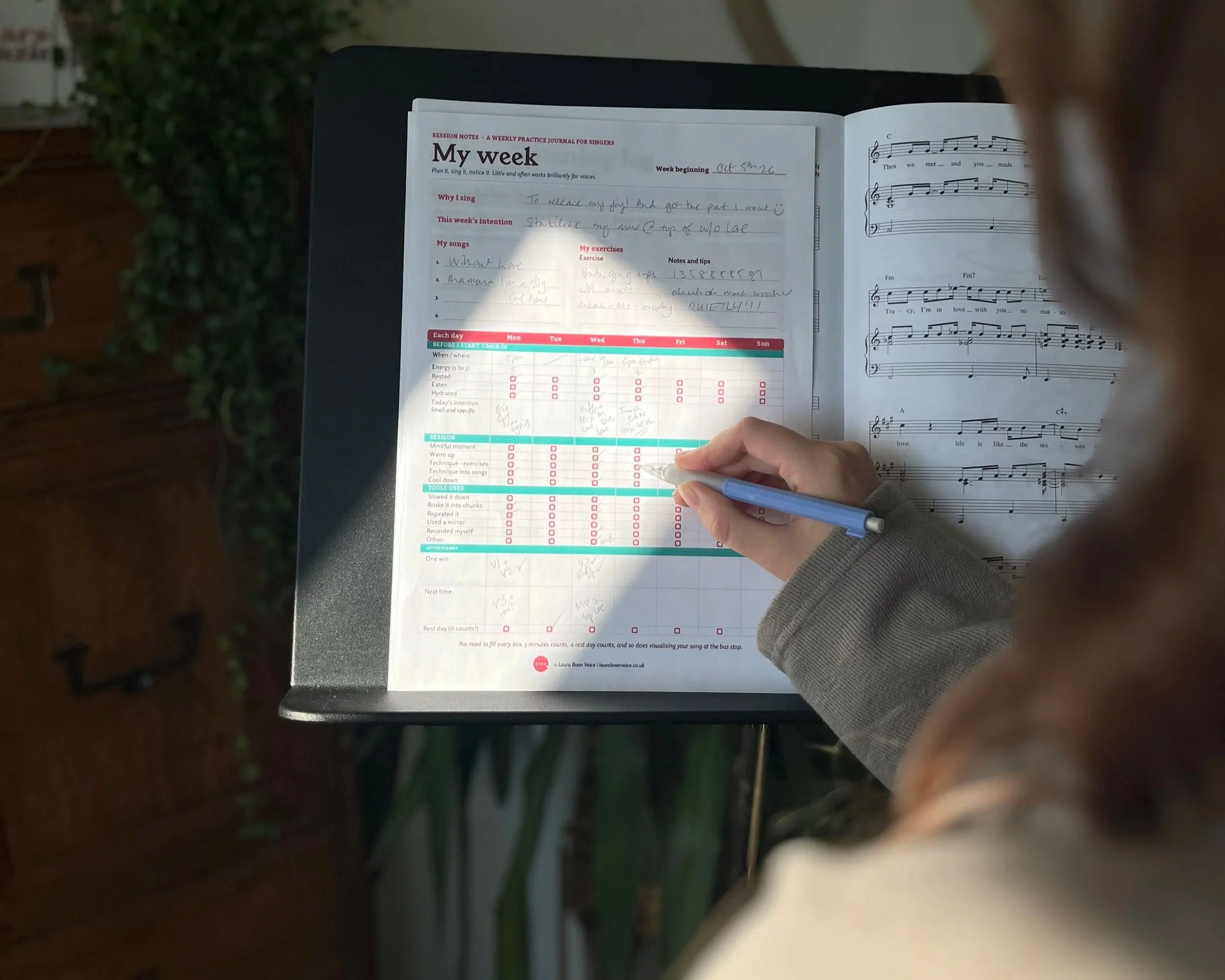
How to practise singing - Part 3: how to actually get your practice done
You know what to practise. You know how to practise. So why is it still so hard to actually do it?
This is the third post in my series on practice: what really makes a difference when you want to make changes to your voice and build new vocal skills. In this one, we're looking at how to pull it all together, and the simple tool that I think makes the biggest difference of all.

How long do I need to take singing lessons for?
How long do I need to have singing lessons for?
In this blog post we look at why awareness, having clear goals and having some guidance from an experienced teacher can best help to answer that question.

Estill Voice Training - Introductory Workshop
On 10th June I ran an Introductory Workshop in Estill Voice Training in the heart of Canterbury. I was joined by a wonderful group of singers, teachers and artists who were so generous in sharing their voices with me! Here’s just a snippet of what they had to say…

What key should I sing it in?
It’s sometimes seen as a badge of honour to be able to sing songs in the original key, but in my opinion this is just silly. Why would you not want to make your singing both comfortable, enjoyable, and have it show you and your voice off to its best? So wherever possible, I always advocate for changing the key to suit your voice. How to find the best key for your voice…

5 easy ways to keep your vocal folds happy
Our vocal folds do such a lot for us, so it’s the least we can do to look after them and keep them happy. Here are 5 easy ways to do just that

Tools and resources to help you learn to sing
As singers, we’re lucky that our instrument is both portable and free. With the exception of all the things we should be doing to take care of ourselves as a whole (eating well, sleeping well, staying hydrated, managing stress levels) it doesn’t require quarterly services or expensive upkeep. However, once we start thinking about voice training, it can benefit from a little investment. Here’s my list of some add-ons that I’ve found useful. Although none of these are essential to a healthy and efficient voice, they can all play a useful role when training it.

How to ad lib (for those who find it scary!)
Some singers find improvising very intuitive, but others find the prospect very daunting! If you’re in the latter camp, then this blog post is for you!

How to practise singing - Part 2
In part 1, we looked at why we should practise and the kind of things we might practice. Now we need to look at how to actually do the practising. Here are some options.

How to practise singing - Part 1
Practice, rehearsal, run-throughs, exercise - whatever you like to call it - when we want to make positive changes to our voices, it’s essential. It’s where the real change happens. Where our range extends, where our agility and flexibility improve, and where we gain vocal stamina. These days we’re all constantly bombarded with distractions in our lives, and so we want to make any time we do devote to practising our singing really count. Practising singing is so much more than just singing through your songs until you ‘get’ them. In this 2-part series, we’ll explore the why, what and how of practice as well as some common pitfalls.

How to warm up your voice
We all know we should warm up our voices before we sing - but how many of us do it religiously, every time? What about warming up for speaking? Here are a few things to think about.

How to do SOVT exercises
What are SOVT exercises? SOVT stands for ‘semi-occluded vocal tract’ - a fancy way of saying that the air is partially blocked on its way out of your mouth. There are several different types of SOVT exercises, which all have different levels of air resistance, and different advantages and disadvantages. The benefits of this type of exercise are scientifically proven, so I encourage my students to build some into their day whenever and wherever they can. Here’s a handy breakdown of the what, when, and how of SOVT exercises.

5 things you should know about starting singing lessons
If you’re venturing into the singing studio for the first time, you may have some anxiety about singing in front of somebody new during the first lessons - don’t worry! It’s totally normal to take a little bit of time to feel settled and relaxed.

6 Ways You Can Practise Singing Silently
As much as we might love singing there are times when we need to be quiet, whether that’s because we are in a place where we can’t sing full volume (such as if it’s very late and you’ve got neighbours, a sleeping baby, or a housemate with a headache), we’re going about our daily lives in public (like in queue at the post office or on a train on the way to work) or we have a vocal health issue that needs vocal rest. In these kinds of circumstances, there are still several ways of practising singing without actually singing. Here are a few ideas for silent practice…

How to get the best out of online singing lessons
Since the pandemic, the world has really opened up, and online lessons can work brilliantly when we get the set-up correct. To help us get the best out of online voice lessons, here’s my go-to checklist